
18 November 2026. Published on Shared Future News
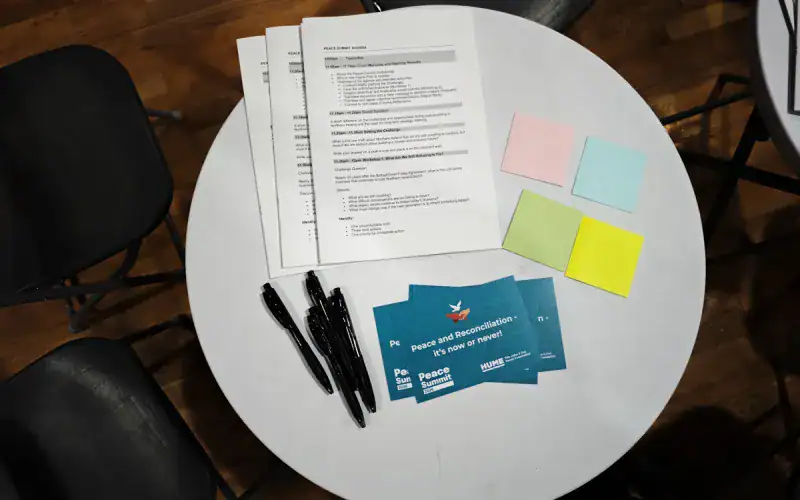
More than 60 practitioners, community workers, and peacebuilders gathered at the Duncairn Centre for Arts and Culture to do something politicians have so far failed to do: draft a plan for peace.
The occasion was the third Peace Summit 2026, organised by the Peace Summit Partnership — a coalition that includes the John and Pat Hume Foundation, Ulster University’s INCORE, Northern Ireland Youth Forum, Youth Action NI, Holywell Trust, Glencree Centre for Peace and Reconciliation, and the Dialogue Practitioners Cooperative (DPC). The venue, a converted church in one of the most divided and deprived corners of these islands, was not chosen by accident.

The goal was to gather community voices around a draft 2028–2038 Peace and Reconciliation Plan — an ambitious framework that maps eight “transformations” needed to move Northern Ireland from managing division to completing the peace process. Those eight transformations range from ending paramilitary coercion and removing physical barriers to building an inclusive and anti-racist society and making peace and reconciliation permanent government business.
Why now, why here
“The highest price paid in the conflict was areas like north Belfast,” said Dympna McGlade of the Peace Summit Partnership, who helped draft the plan. “And the highest price paid in peace are areas like north Belfast.” She ticked off the anniversaries converging on 2028: 60 years since the Troubles began, 30 years since the Good Friday Agreement, 25 years of policing reform. “If 2028 is just a commemoration and not a point of delivery,” she said, “we’ll go on for another 30 years going round in circles with our foot nailed to the floor.”
Tim Attwood, Secretary of the John and Pat Hume Foundation, described the frustrations that brought the summit into being. When the partnership secured a cross-departmental commitment to peace in the Programme for Government, the first minister they wrote to, the Department of Finance, responded that it was not their department’s responsibility. “That’s a big problem,” Attwood said. A meeting in Stormont six weeks earlier had ended in disappointment when a junior minister pulled out at the last minute.

Anne Carr of DPC, who facilitated the morning’s table sessions and has been involved in peacebuilding for over 50 years, opened the workshops by introducing Abeer, a storytelling practitioner from Ramallah who had arrived in Belfast two years ago. On the way to the summit that morning, Abir had mentioned to Carr that the Arabic word for summit means “never giving up” (i.e. to reach a summit or peak).
“One thing we know,” Carr said, “is that the people in this room have already made that decision.”
From the tables
The workshop sessions asked two hard questions: what is the unfinished business that continues to hold Northern Ireland back, and what must political leaders do to earn trust? After 30 minutes of facilitated table discussion, each facilitator reported back a single key point.

Tim Magowan, Director of the 174 Trust, spoke for the table that had converged on a phrase that would become the summit’s refrain. “Our key point was working together towards a thriving future for all,” he said. “We’ve come through the horrible Troubles. We’ve been in purgatory for 30 years, but we need to build a future which works for everyone.”
The language debate had been lively at that table. Magowan argued that “peace and reconciliation” is the language of a generation that lived through the conflict — it harks backwards. Younger people talk instead about inclusion, diversity, and thriving. He drew a comparison with climate activists who abandoned the phrase “net zero” in favour of “warmer homes, green jobs, benefit” — the same message, reframed around aspiration rather than crisis. The plan, he suggested, needs to speak to those who have never known the Troubles but are living daily with their consequences.
Bridget Loughran’s table had grappled with what she described as the “absent stuff”: the structures, systems, and mechanisms that the peace process promised and never delivered. “We’re still in a process,” she said, “but it’s not being acknowledged, and it’s not out there.” Her table’s sharpest concern was the absence of young people: not engaged, not informed, not empowered. “We cannot create change without them.”
Jim O’Neill identified the fragmentation of existing strategies as a critical failure. Anti-poverty strategies, gender equality strategies, good relations frameworks — all address overlapping needs but operate in silos. “They need to work together,” he said, “because they all have a lot in common.” He called for politicians to build trust among themselves as a precondition for anything else — perhaps, he suggested, one dedicated session a year where political leaders come together and genuinely develop a trust-building process, leaving their party agendas at the door.
Maggie McKeever brought the conversation back to fundamentals. Trust, her table concluded, cannot be assumed or declared — it has to be earned through action and accountability. The measure of success is not the language politicians use or the plans they publish, but whether people actually see their lives improve. “People need to have more confidence, more space, and more pathways so that they can be genuine participants,” she said. It was a deliberately practical test: not what leaders say, but what changes on the ground.
Lyn Moffet’s table called for an end to the community labels CNR and PUL — Catholic/Nationalist/Republican and Protestant/Unionist/Loyalist. “That simply doesn’t reflect society as it is today in Northern Ireland,” she said. Politicians need to use language that reflects the common good and public interest rather than fomenting division. And the civic voice, she added, must get louder — including the voices of young people and new communities.

Angela Mulholland brought the most urgent message. Her table had identified trauma and legacy as the unaddressed root beneath everything else. “Everything is exacerbated by poverty and deprivation,” she said, “and that’s still in existence.” A participant at her table had observed that trauma is visibly played out in Stormont itself — not only in communities, but in the politicians who govern them. “How do we recognise and support people who are still dealing with trauma?” Mulholland asked. Her table called for a genuine truth and reconciliation commission — drawing on models beyond South Africa — and for an ombudsman for peace and reconciliation.
What comes next
Closing the summit, Dympna McGlade reminded the room of who the plan is ultimately for. When you speak to families on the ground — especially women — and ask what they want for future generations, the answer is consistent. “Not what we have,” she said. “We want something better.”

Tim Attwood ended with a story about Dr Ali Elaydi, a surgeon from Gaza who visits Belfast regularly and has been inspired by John Hume’s decades of resilience. A man who has operated on children in a conflict incomparably more devastating than Northern Ireland’s is uplifted, Attwood said, by what people here have managed to build. “Despite our flaws,” he reflected, “our situation can be uplifting for people in conflicts so much worse than ours.”
The Peace Summit Partnership will hold further summits in Derry the following week, then thematic consultations with section 75 groups from mid-January to mid-March. A youth-specific summit is planned with Northern Ireland Youth Forum and Youth Action NI. The final 2028–2038 Peace and Reconciliation Plan is set to launch in March, possibly with international representatives present.
The draft plan, available from the John and Pat Hume Foundation, invites responses from organisations and individuals who could not attend. The deadline for written submissions is open.
The Peace Summit Partnership can be contacted at info@humefoundation.org.